Cold Water Systems & Chillers
The Flexible Solution for Process and Building Cooling
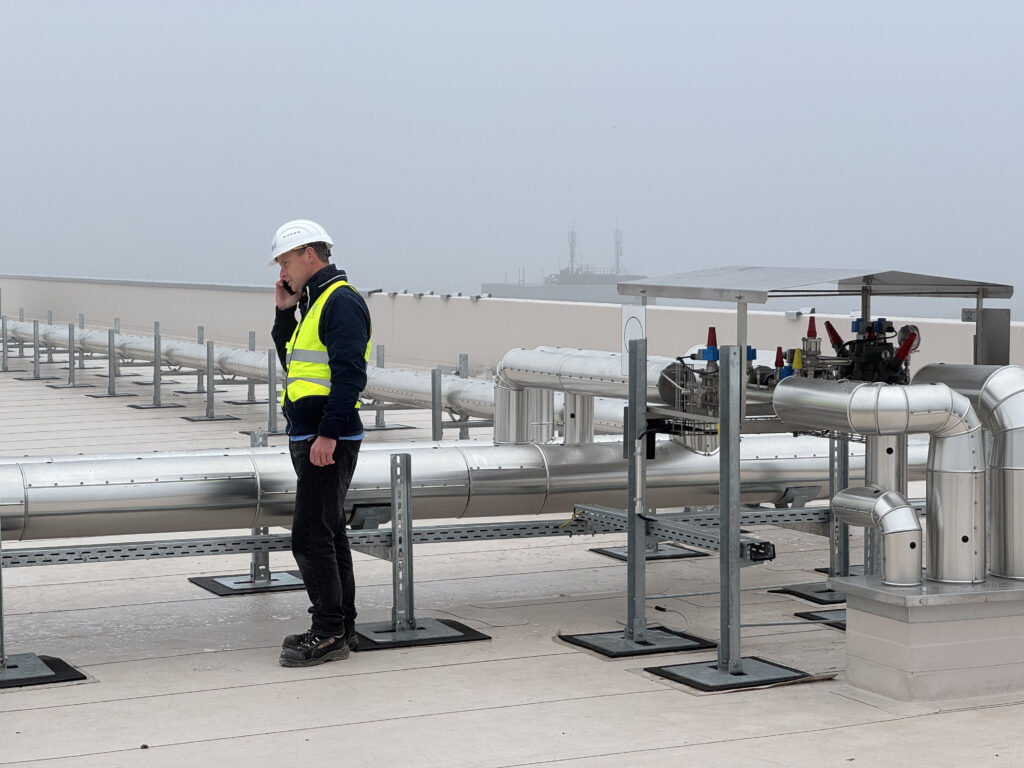
Chillers are the backbone of modern building air conditioning and industrial process cooling. The principle is as simple as it is ingenious: The refrigeration cycle is confined to the generator unit, while a neutral coolant (water or brine) circulates within the building. cold.world ENGINEERING designs highly efficient chilled water systems that are perfectly hydraulically balanced and—whenever possible—use natural refrigerants such as propane (R290) or ammonia.

Indirect Cooling: Safety Meets Efficiency
Why are more and more companies opting for chilled water systems instead of direct refrigerant lines? The answer lies in the combination of safety and flexibility.
- Minimum refrigerant charge: The refrigerant is contained compactly and safely within the chiller (often located outdoors). Only water flows through the building itself. This drastically minimizes risks and inspection requirements.
- Ideal for propane (R290): Since the flammable refrigerant does not enter occupied spaces, chillers are the perfect technology for safely using environmentally friendly propane.
- Enormous savings potential through “free cooling”: During the cooler months (fall/winter), the outside air can cool the water without requiring the energy-intensive refrigeration compressor to run. This significantly reduces annual operating costs.
- Easy expandability: A chilled water system can be easily expanded or modified without having to interfere with the refrigeration cycle.
Our Engineering Services: More Than Just Installing the Chiller
A chiller is only as good as the hydraulic system behind it. We don’t supply “off-the-shelf products”; instead, we provide a fully functional, integrated system.
1. Hydraulic Design & Network Analysis
We size piping, buffer tanks, and pump sets precisely to meet your needs. Proper hydraulic balancing prevents under-supply and saves on pump power consumption.
2. Focus on natural refrigerants (R290 & R717)
We prefer to design chillers that use natural refrigerants. Air-cooled propane chillers (R290), in particular, offer outstanding efficiency today and are future-proof (no F-gas phase-down). For high-capacity applications, we rely on ammonia chillers.
3. Integration of Free Cooling Systems
We integrate free cooling systems so that your chiller shuts down when outdoor temperatures are low and nature takes over. This is the most effective way to reduce energy costs.
Applications for Our Cold Water Solutions
- Industrial Process Cooling: Cooling of machines, lasers, plastic injection molding machines, or extruders.
- Building Air Conditioning: Supply of ceiling cooling systems or recirculating air cooling units in offices and hotels.
- Data Centers / Server Rooms: Fail-safe cooling with redundancy solutions.
Frequently Asked Questions About Chillers
What is the difference between chilled water and direct expansion (VRF/split) systems? In a split system, refrigerant flows through the building. In a chilled-water system, water (or a water-glycol mixture) flows through the building. For higher capacities, chilled-water systems are often more durable, require less maintenance, and use significantly less chemical refrigerant (or replace it with natural alternatives).
Do I need glycol in the water? If parts of the system (e.g., the rooftop chiller or the recooler) are exposed to freezing temperatures, an antifreeze agent (glycol) is necessary to prevent the pipes from freezing in the winter or during downtime. We can advise you on the correct concentration to minimize efficiency losses.
Schedule an Initial Consultation
Schedule a free initial consultation now.